In this guide
- Start with the work you have actually been assigned
- Find the controlling plan, not a collection of tips
- Check arrangements in the real geography of the job
- Treat new exposure as a real change
- An editorial case: the assignment moves at midday
- Bring five questions to the briefing
- Keep the whole shift in view
- Sources and limits
An outdoor assignment in Phoenix begins with more than the day’s forecast. A park employee may move between a tree canopy and an exposed court. A water crew may work beside a paved street. A solid waste route includes repeated stops, vehicle transitions, and changing access. Those settings create different questions even when a phone displays the same temperature. Good preparation makes the actual assignment visible to the people responsible for planning it.
This guide is an independent conversation aid. Use your employer’s current safety plan, training, and supervision for work decisions. It provides no heat threshold, fitness test, medical advice, or permission to continue working. If someone may be in immediate danger, use the applicable emergency process; reading or completing a checklist must not delay help.
Start with the work you have actually been assigned
Write one plain sentence describing the planned work and location. “Outdoor maintenance” is too broad to reveal much. “Assigned park grounds work that moves between the athletic area and surrounding paths” raises useful questions about travel within the site, equipment, and available facilities. Do not invent a more detailed plan than the supervisor has provided. An unknown task or location is itself something to clarify.
Then distinguish normal duties from changes. A different vehicle, an unfamiliar park, extra protective clothing, or a task requiring more physical effort can matter. OSHA identifies exertion, environmental conditions, lack of acclimatization, and heat-retaining clothing among occupational heat-risk factors. Its overview of heat exposure gives the general context; the department determines how that context applies to this assignment. Living in Phoenix or enjoying outdoor recreation does not answer that workplace question.
Find the controlling plan, not a collection of tips
Ask where to find the current department instructions and who explains them before work. Phoenix publishes an annual Heat Response Plan describing public programs and services. That citywide public document is useful background, but a reader should not extract a universal employee break schedule from it. Public cooling resources, public trail restrictions, and an employer’s worksite controls serve different purposes.
Useful preparation means knowing which instructions apply to your crew and assignment, how changes are communicated, and who can resolve a conflict. If a route sheet and a verbal instruction appear inconsistent, bring that specific discrepancy to the responsible supervisor. Quietly combining fragments from old training, a public webpage, and another department’s habits produces a plan that nobody actually approved.
Check arrangements in the real geography of the job
“Shade available” can conceal a practical gap. Is the identified location relevant to where the crew will be, and is access part of the approved arrangement? “Water available” also needs a worksite answer rather than an assumption about a nearby building. OSHA’s prevention guidance identifies rest, shade, fluids, training, and engineering or administrative controls as elements of prevention. It does not make a nearby public amenity an authorized substitute for the employer’s arrangements.
For preparation, ask about the places and resources the plan specifies without designing your own replacements. A park ramada can be reserved, distant, or unsuitable for a particular crew’s needs. A vehicle may serve several purposes and may not be the designated recovery location. The right output is a clarified arrangement, not a photograph of something that looks useful from a distance.
Treat new exposure as a real change
A person can be experienced in municipal work and still be new to the day’s heat exposure. OSHA’s guidance on new and returning workers includes changes in activities and seasonal conditions, as well as people returning after time away. This article deliberately does not reproduce a numerical acclimatization schedule. That would invite readers to apply a generic number to circumstances requiring employer oversight.
Ask how the applicable plan addresses a new assignment or a return to heat-exposed work. Keep personal health questions in the appropriate private channel. A public website, a coworker’s anecdote, or this journal’s local planning tool should never collect medications, diagnoses, or medical histories. The useful workplace discussion concerns the approved process, the relevant supervisor, and arrangements that have actually been confirmed.
An editorial case: the assignment moves at midday
Imagine a hypothetical parks employee whose morning assignment is near a recreation building. A later request would move the employee to a more exposed area across the park. The employee has already received the day’s briefing, but its resource locations were discussed around the original work area. Nothing in this scenario establishes that the second task is safe or unsafe.
The practical response is to raise the changed location before treating the earlier discussion as complete. Questions include whether the same arrangements apply, who coordinates the move, and whether the task or equipment changes the plan. The supervisor’s answer may confirm existing arrangements or require a different approach. The lesson is about recognizing a changed assumption, rather than deciding heat exposure through confidence or a checklist score.
Bring five questions to the briefing
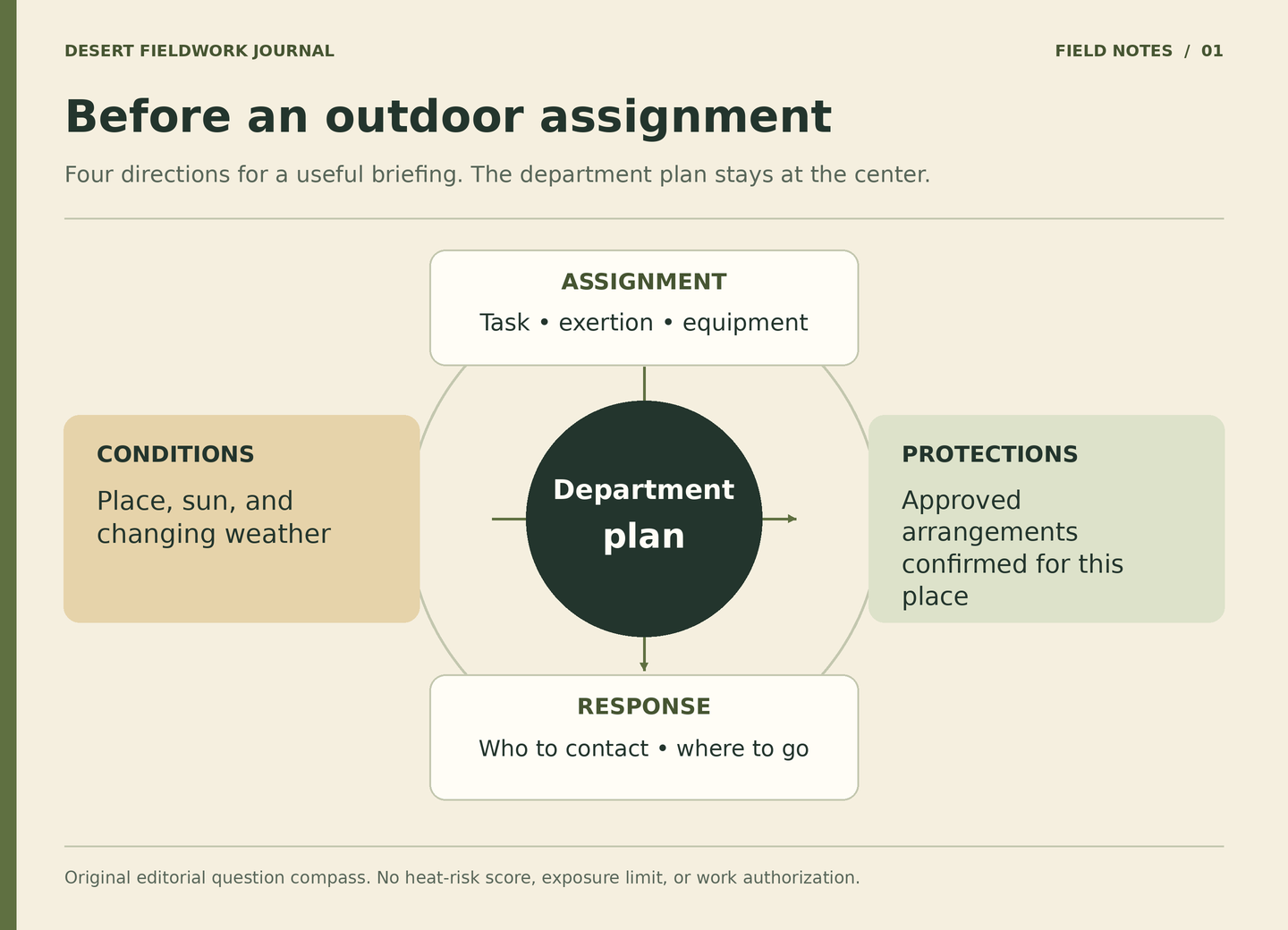
- What work and locations does today’s instruction actually cover, including travel between areas?
- Which current department heat plan and task-specific training apply, and where can I review them?
- What approved water, rest, and cooling arrangements apply at those locations?
- How are new exposure, returning workers, and changed assignments addressed by the responsible staff?
- How do I report a concern or obtain immediate help, and who confirms any change to the assignment?
Write the answers in the format your employer permits. A personal preparation note should contain no sensitive coworker information, access codes, or copied internal safety records. Mark unresolved questions plainly. The goal is to make it easier to ask the right person, not to produce a document that appears to certify readiness.
Keep the whole shift in view
Preparation should also account for the yard, staging location, and return journey within the assignment. Outdoor work does not begin only when a tool touches an asset. Ask where the official briefing covers these transitions and how the responsible person communicates a weather-related change. See fleet-yard readiness questions for the vehicle-and-equipment side, and the overlapping Phoenix operations calendar for the difference between seasonal preparation and current conditions.
For career explorers, these questions reveal a concrete feature of outdoor public service: preparation is part of doing the job. They do not prove eligibility for a role, replace training, or require a person to demonstrate toughness. A useful conversation leaves fewer assumptions about the actual work and clearer knowledge of whose instructions govern it.
Sources and limits
Public sources checked October 5, 2026. Editorial examples are hypothetical; official instructions and case-specific decisions remain with the responsible City service.
- Phoenix Heat Response Plan
Public heat-response planning context; does not establish an individual employee work rule or current worksite conditions.
- OSHA: Heat Prevention
High-level occupational heat-prevention principles; no legal determination, exposure threshold, medical advice, or Phoenix department procedure is inferred.
- OSHA: Protecting New Workers
New and returning workers and changing heat exposure; numerical acclimatization schedules are intentionally not reproduced.
- OSHA: Working in Outdoor and Indoor Heat Environments
General heat-risk factors, including exertion and clothing; no assessment of an individual worker.