In this guide
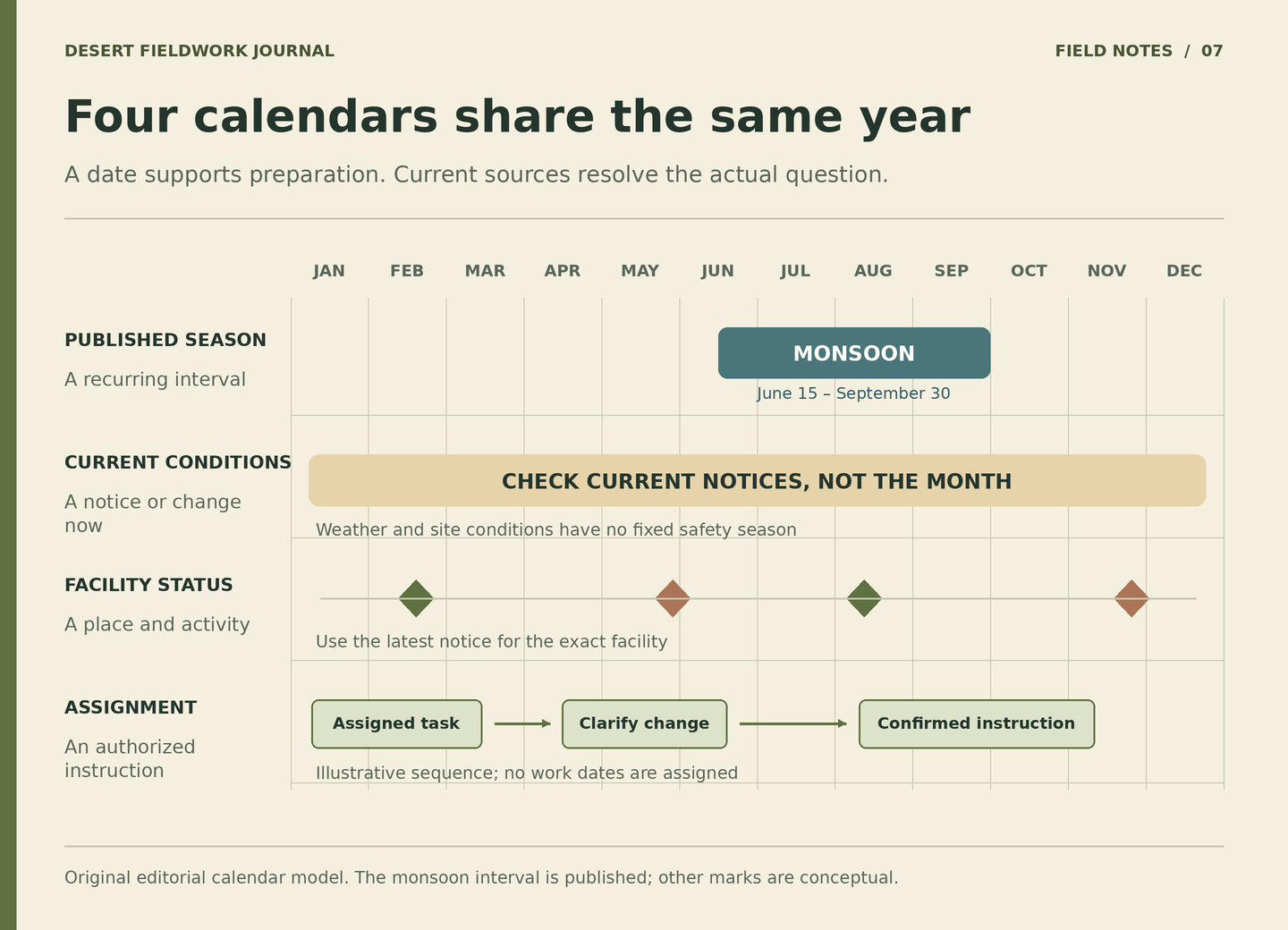
One calendar cannot describe Phoenix outdoor operations. A published season, a current weather condition, a facility’s public schedule, and a worker’s assigned task can all point to different time frames. Treating October as automatically cool or a summer opening announcement as permanently current loses that distinction. The useful habit is to ask which clock the statement belongs to.
This editorial model is for preparation and source reading. It is not a City staffing calendar, a weather forecast, or a work-clearance tool. It assigns no maintenance dates, automatic closures, or employee schedule changes.
Four clocks to keep visible
A seasonal calendar describes a recurring interval. Phoenix’s Monsoon Resources identifies June 15 through September 30. That helps people prepare for a period of expected concern without limiting the possibility of storms to those dates.
A condition-based notice responds to something happening or forecast now. The Trail Heat Safety Program ties named restrictions to an Extreme Heat Warning. Knowing the month does not tell a reader whether that warning is currently in effect.
A facility calendar describes public use at a place. On October 5, 2026, the pool directory says pools are closed until the 2027 season. That statement does not establish an employee’s maintenance assignment or a future opening day.
An assignment calendar is the employer’s actual instruction for a person or crew. Public web pages can help explain the service context, but they do not change that instruction. Staff need to know how an authorized revision reaches them.
A broad maintenance season is not a street appointment
The Street Maintenance Division describes routine annual maintenance from early spring through fall. That broad description cannot tell a resident when a particular block will be treated. It also cannot establish whether weather or another project has changed a specific assignment.
This is a common source-reading trap: converting a general program pattern into a local commitment. A better question names the street or facility and asks for its current official information. For employees, the equivalent question names the assigned task and asks whether the existing instruction still applies.
An editorial case: three October assumptions
Imagine a hypothetical employee hearing three claims in one morning: monsoon season is over, the pool is closed, and street work usually happens in fall. None of those statements alone decides the person’s outdoor assignment that day.
The useful preparation separates them. Current weather and employer instructions govern the immediate work questions. The pool directory governs the public-season answer. A specific street project’s information governs any promised work date. The employee can use each statement for its proper purpose without combining them into a fictional citywide schedule.
Make a seasonal question sheet
- Published season: what interval is named, by which source, and for what purpose?
- Current condition: which official notice or employer communication needs checking now?
- Facility status: what exact place and public activity does the latest notice cover?
- Assignment: who confirms the work instruction and any revision?
The journal’s Field Brief Builder can generate place-specific questions from fixed choices. It does not fetch weather, locate the user, store health details, or determine whether work may proceed. Use it to prepare a conversation, then obtain the actual answers from responsible sources.
For career explorers, overlapping calendars show why outdoor service includes adapting to conditions without improvising authority. For current workers, they provide a simple way to expose an assumption before it becomes a mistaken public promise. Continue with heat-aware preparation or pool seasonal transitions for the question most relevant to your place.
Sources and limits
Public sources checked October 5, 2026. Editorial examples are hypothetical; official instructions and case-specific decisions remain with the responsible City service.
- Phoenix Monsoon Resources
Published seasonal dates, public reporting routes, and storm-resource context; no live warning or employee dispatch instruction.
- Phoenix Street Maintenance Division
Public maintenance scope and broad spring-to-fall routine work season; not a schedule for a specific street.
- Phoenix Find a Pool
Directory stated pools closed until the 2027 season on October 5, 2026; future opening dates are not inferred.
- Phoenix Trail Heat Safety Program
Published warning-triggered trail restrictions as checked; no current warning, full trail-condition assessment, or employee work authorization.