In this guide
- See a connected landscape, then describe one place precisely
- Separate water movement from water quality
- Notice what changed without claiming what caused it
- Use the public maintenance material at the right level
- An editorial case: leaves at the curb, containers uphill
- Build a drainage observation card
- Think beyond the first clear street
- Sources and limits
A monsoon can make an ordinary curb opening, a shallow basin, or a dry wash suddenly important to a neighborhood. For Phoenix workers and career explorers, the useful starting point is to understand what these places do and what an observation can establish. A visible obstruction, an unusual deposit, and a flooded route are different facts. They may concern different staff, and none gives an observer permission to enter the drainage system.
Phoenix’s Monsoon Resources identifies June 15 through September 30 as the monsoon season. Those dates support seasonal preparation; they are not a promise that storms or flooding occur only within that interval. This is an editorial guide to reading places and asking questions. Follow current warnings, closures, employer procedures, and emergency instructions rather than using it as a field inspection or cleanup method.
See a connected landscape, then describe one place precisely
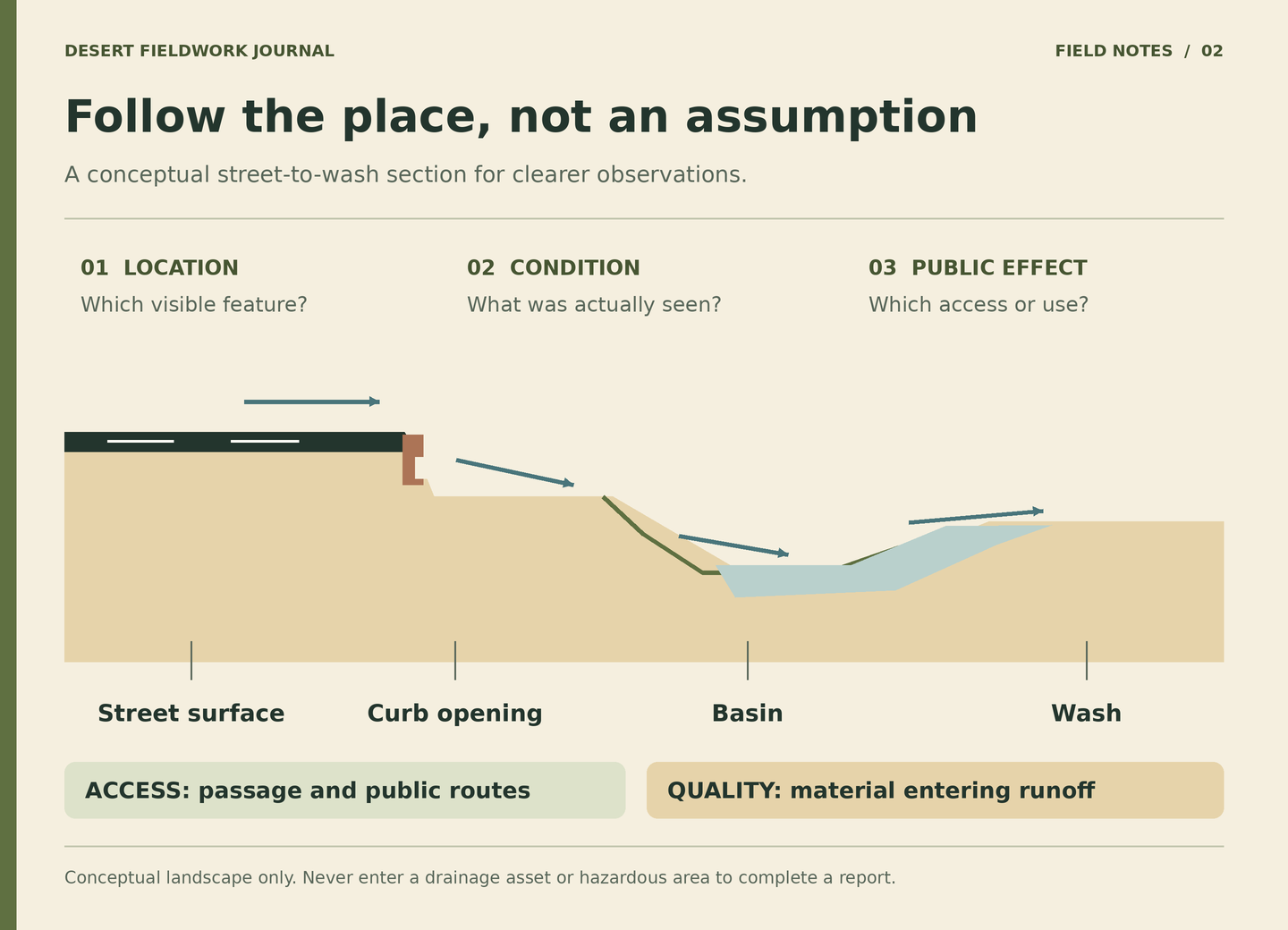
Rain falling on streets and developed land can move through gutters, inlets, basins, channels, and washes. Phoenix’s Water Services FAQs explains that storm drainage differs from the sanitary sewer system: runoff can reach rivers, washes, and retention basins without sewage treatment. That distinction makes litter and other material near an inlet relevant even when no rain is falling.
A useful observation nevertheless stays grounded in one identifiable location. “The drainage is bad across the area” cannot show where a receiving crew should begin its review. “Material is visible across the curb opening on the east side of the named intersection” gives a place and a visible condition. Use directions and landmarks only when you can establish them from a safe, permitted position. Do not approach moving water, traffic, unstable ground, or equipment to improve a description.
Separate water movement from water quality
An access problem concerns the physical passage of runoff or the public’s ability to use a place. A pollution concern involves material that may enter or already be in that runoff. A pile of ordinary-looking debris can raise both questions, but an observer should not turn an appearance into a chemical identification. Describe an unfamiliar substance as unfamiliar and use the appropriate reporting route.
The Phoenix Stormwater Management Program explains that Streets maintains drains and washes while stormwater staff investigates illicit discharges and coordinates the City’s program. Other departments have additional responsibilities. This public description explains why “stormwater” is not a single catch-all job. It does not identify the assigned crew, establish ownership of a particular wash, or substitute for an employee’s internal reporting instructions.
Notice what changed without claiming what caused it
After a storm, a report may be more useful when it distinguishes an observation from a comparison. You might know that a path was open during an earlier authorized visit and is now covered by deposited material. You may not know whether the deposit came from a construction site, an upstream wash, or a damaged landscape. Preserve that difference in the wording.
Time matters because a place can change between the observation and the review. Say when something was seen, not that it is still happening unless you have current knowledge. Photos, where permitted and safely obtained, can preserve context, but they do not show hidden conditions below water or behind debris. A wide location view can be more informative than a close-up that loses the asset and surrounding access routes.
Use the public maintenance material at the right level
The 2025 Stormwater Management Plan describes drainage maintenance and recognizes new needs following monsoon events. It is helpful evidence that drainage stewardship includes recurring work and response to changed conditions. It should not become a self-assigned inspection route or an invitation to copy equipment procedures from a public document.
Similarly, the City’s September 2023 wash-maintenance report explains that drainage responsibilities can belong to the City, private owners, or other agencies. The older report is used here for that ownership distinction, not its historic budget or asset counts. When an unfamiliar wash borders a park or street, proximity alone does not establish who maintains it. A good report allows the receiving authority to make that determination.
An editorial case: leaves at the curb, containers uphill
Consider a hypothetical employee passing an assigned work area after a storm. From a permitted route, the employee sees plant debris near a curb inlet and several unidentified containers farther up the block. A resident says everything should be swept into the gutter before the next rain. That suggestion combines a cleanup action with an unsupported assumption about the material.
A useful observation would identify the inlet, describe the visible plant debris, separately describe the containers without opening them, and note the resident’s access concern if relevant. The employee uses the required reporting process and does not improvise removal, sampling, or disposal. The receiving staff can then assess drainage, material handling, and ownership with the appropriate authority. The output is a place-specific account, not a diagnosis or an informal cleanup order.
Build a drainage observation card
- Place: the named street, park, or public landmark and the particular inlet, basin edge, or wash segment, where known
- Time: when the condition was observed and whether it is still being observed
- Visible facts: debris, deposition, standing or moving water, damaged features, or an unfamiliar material, without inferred causes
- Public effect: the observed effect on a path, crossing, entrance, or other access point
- Boundary: what could not be seen or confirmed and which authorized channel received the information
This is an editorial note structure, not the City’s official form. Do not delay an urgent call to complete it. Phoenix’s current monsoon resource page lists public routes for street issues, signal outages, and emergencies; employees should also know their department’s required channels. A life-threatening situation calls for emergency help rather than a routine online submission.
Think beyond the first clear street
A reopened travel lane does not by itself establish that a nearby basin, trail, or collection area has returned to normal. Different places can require different assessments. Avoid promising a cleanup or reopening time based on one visible crew’s progress. The best public-facing explanation identifies the specific confirmed status and directs remaining questions to the responsible source.
For a closer look at ownership and access around channels, read observing a wash edge. For the separate question of what happens to storm-created waste, use storm debris and service streams. The central habit is simple: describe the place well enough to help authorized staff, while leaving technical assessment and intervention to the people assigned to them.
Sources and limits
Public sources checked October 5, 2026. Editorial examples are hypothetical; official instructions and case-specific decisions remain with the responsible City service.
- Phoenix Monsoon Resources
Published seasonal dates, public reporting routes, and storm-resource context; no live warning or employee dispatch instruction.
- Phoenix Stormwater Management Program
Public division of stormwater responsibilities and pollution concerns; does not assign authority for a particular site.
- Phoenix 2025 Stormwater Management Plan
Published drainage-maintenance context; not a field procedure, current assignment, or authorization to enter a drainage asset.
- Storm Drain and Wash Maintenance Update, September 20, 2023
Historical City report establishing that wash ownership and maintenance responsibilities vary; historical counts and budgets are not treated as current.
- Phoenix Water Services FAQs
Public distinction between sanitary sewer and storm drainage and general service questions; not a troubleshooting procedure.