In this guide
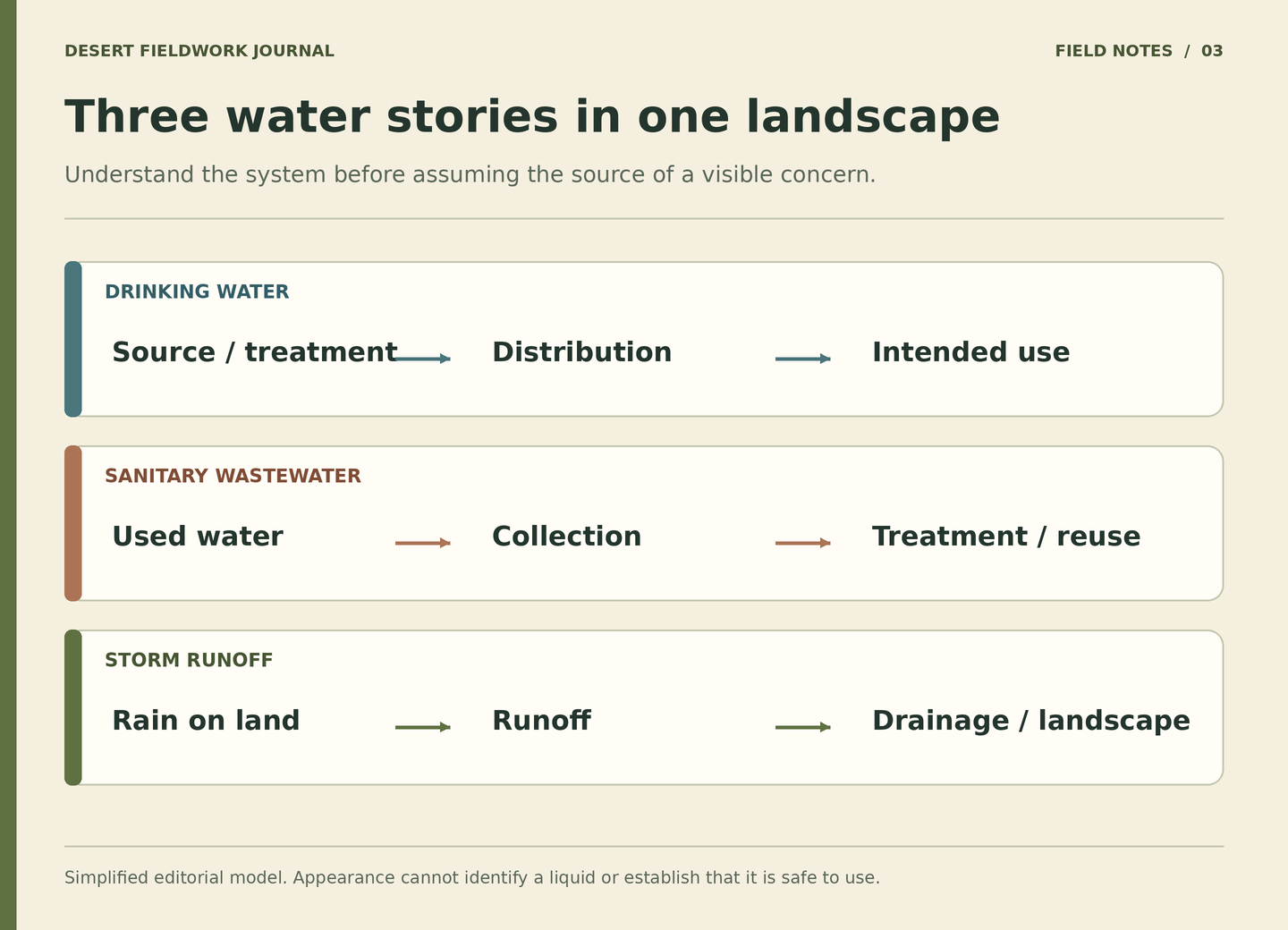
- Drinking water has a supply direction and an operating purpose
- Wastewater starts a different journey
- Runoff belongs to a separate drainage story
- Ownership can change along an apparently continuous line
- An editorial case: irrigation running near a wet street
- Ask about decisions, not just equipment names
- Follow the public effect through the place
- Sources and limits
Water work in Phoenix is easy to oversimplify because much of the infrastructure is underground. A wet street, an irrigation area, and a channel carrying runoff can all look like “a water problem.” Yet they may involve different systems, different owners, and different response arrangements. Recognizing those distinctions helps an employee explain a concern and helps a career explorer understand the setting behind a technical role.
This article gives public infrastructure context. It does not teach valve operation, excavation, sampling, confined-space entry, electrical work, treatment, or repair. A visible asset is not an invitation to inspect it physically. Follow employer training and authorization, and use the official emergency route when a concern is urgent. Appearance, odor, or a map alone cannot establish that water is safe to touch or use.
Drinking water has a supply direction and an operating purpose
Phoenix’s infrastructure overview describes treatment plants, transmission and distribution mains, service lines, storage, and pumping facilities. Those components have different purposes: moving water across the system, bringing it to customers, holding supplies, or managing pressure. The public explanation is useful for understanding why a hydrant or reservoir is part of a much larger service.
For someone preparing for outdoor work, the next question is about the actual assignment. Is the role observing visible conditions, maintaining an authorized asset, supporting access around a repair, or communicating with affected users? Those are distinct responsibilities. A person supporting a work area does not gain permission to operate a component because its general purpose is explained online. Knowing the vocabulary should improve the question asked of the qualified crew.
Wastewater starts a different journey
Sanitary wastewater is collected and conveyed for treatment after use. The Water Services department overview describes treated wastewater supporting uses including industrial cooling, agriculture, and habitat restoration. These destinations illustrate stewardship beyond disposal. They do not show the quality or intended use of water found at any particular location.
Phoenix also publishes information about advanced water purification. Read the difference between nonpotable recycled water and advanced treatment carefully. A planned or described treatment project is not proof that every related facility has been commissioned or that any existing irrigation supply is drinking water. This journal does not infer an operating milestone from a program description. Current official project communications and qualified staff supply that status.
Runoff belongs to a separate drainage story
The City’s Water Services FAQs distinguishes storm runoff from the sanitary sewer system. For a field observer, this changes how to describe a concern near a gutter or wash. A material entering storm drainage should not be assumed to pass through a wastewater treatment plant. It also means that a stormwater issue and a sewer overflow may require different reporting descriptions.
Avoid diagnosing a liquid’s source from the nearest cover, valve box, or landscaped area. A more reliable report says where the liquid was visible, when it was seen, and what public area it affected. If identification is uncertain, say so. Reporting uncertainty accurately is useful work; a confident but unsupported system label can send the first reviewer toward the wrong asset.
Ownership can change along an apparently continuous line
The physical connection between a building and a public system can make the maintenance boundary difficult to see. Phoenix’s General Service Issues page addresses private sewer-line responsibilities and other customer concerns. That public information is a starting point for questions, not a property-specific determination by this journal. A worker should not promise that the City will repair an asset simply because water or wastewater service reaches the property.
Ask who establishes the boundary for the task, which records or approved markings apply, and what the crew is authorized to handle. Do not open a box, remove a cover, trace an underground line, or enter a facility to satisfy personal curiosity. Career exploration can use public descriptions and authorized conversations without becoming an improvised inspection.
An editorial case: irrigation running near a wet street
Imagine a hypothetical park employee noticing a wet area near a street while landscape irrigation is also visible elsewhere in the park. A passerby concludes that a broken main must be responsible. The employee has no test result, asset assessment, or instruction identifying the source. The simultaneous irrigation is relevant context, but it does not settle the cause either.
A helpful report separates those facts: the particular wet area, the observation time, the visible effect on public access, and the separate irrigation activity. The employee contacts the designated supervisor or reporting channel rather than adjusting nearby equipment. If the situation presents a water or sewer emergency, the official Water Services contact page identifies the public 24/7 hotline as 602-261-8000. That route is distinct from routine billing and water-conservation questions.
Ask about decisions, not just equipment names
A role-specific conversation becomes more useful when it focuses on what the person must establish before acting. For an authorized operator, that may concern the applicable procedure and current system status. For a support employee, it may concern work-area access and how to communicate a resident’s question. For a prospective employee, it may concern how specialized training and supervision relate to the duties described by the employer.
- Which water system and asset does this assignment concern, and who confirms that identification?
- Is the task observation, support, inspection, operation, maintenance, or public communication?
- What access and task permissions apply, beyond simply being employed by the City?
- Where does the responsibility change between the public system and another owner?
- Which information may be shared publicly, and who provides current service or restoration statements?
These questions should produce a clearer responsibility description. They do not establish licenses, credentials, vacancies, or promotion routes. Requirements belong to the actual position and current employer materials. A general public article cannot determine whether someone’s prior experience authorizes a technical duty.
Follow the public effect through the place
A repair may affect a sidewalk, driveway, bus access point, or adjacent park use even when the principal task is underground. Someone assigned to support the work should understand which access information has been confirmed and who can change it. Do not treat a resident’s ability to see the work as permission to enter the work area, or a repair’s visible completion as proof of service restoration.
Continue with water-repair access questions when the concern is how a neighborhood uses the space around the work. Use irrigation reporting when the visible issue involves a landscape. The useful field habit is to connect an observation to the correct system without pretending that observation supplies technical authority.
Sources and limits
Public sources checked October 5, 2026. Editorial examples are hypothetical; official instructions and case-specific decisions remain with the responsible City service.
- Phoenix Water Services: Our Infrastructure
Conceptual drinking-water and wastewater asset functions; no live condition, ownership determination, or operational instruction.
- About Phoenix Water Services
Phoenix wastewater reuse destinations and public utility mission; not a quality determination for a particular discharge.
- Phoenix Advanced Purified Water
Distinction between existing nonpotable reuse and advanced purification; project descriptions are not treated as commissioning announcements.
- Contact Phoenix Water Services
Verified public emergency, leak, customer-service, and water-conservation routes; employee internal reporting may differ.
- Phoenix Water Services FAQs
Public distinction between sanitary sewer and storm drainage and general service questions; not a troubleshooting procedure.
- Phoenix Water Services: General Service Issues
Public information about service concerns and private sewer-line responsibility; no conclusion about an individual property.