In this guide
A road surface can look faded, patched, cracked, or unusually light without revealing the correct maintenance treatment. Phoenix street stewardship combines visible conditions with information unavailable to a passerby. A useful field observation therefore identifies what can actually be seen and where it affects use. It does not announce that a street needs reconstruction or that a particular coating has failed.
The Street Maintenance Division describes work ranging from patching to resurfacing and reconstruction, within the City’s jurisdiction. It also distinguishes public streets from private streets and state routes maintained by other agencies. Before attaching a conclusion to a report, establish the actual location and leave the treatment decision to the responsible staff.
Describe the place a traveler encounters
A defect near a curb, a patched area across a lane, and loose-looking material near an entrance create different location questions. From a safe and permitted position, identify the street, nearest intersection, side or direction where known, and the observed condition. Do not step into a lane, stop in an unsafe place, measure a hole, or disturb the surface to improve the report.
The public effect is helpful context: a condition near a pedestrian crossing, for example, should be identified as such. Avoid predicting vehicle damage or declaring a structure unsound without evidence. “Visible depression near the marked crossing” is a usable observation. “The road is collapsing because the water department repaired it incorrectly” adds a cause and accusation the observer may be unable to support.
Cool pavement has several measures of performance
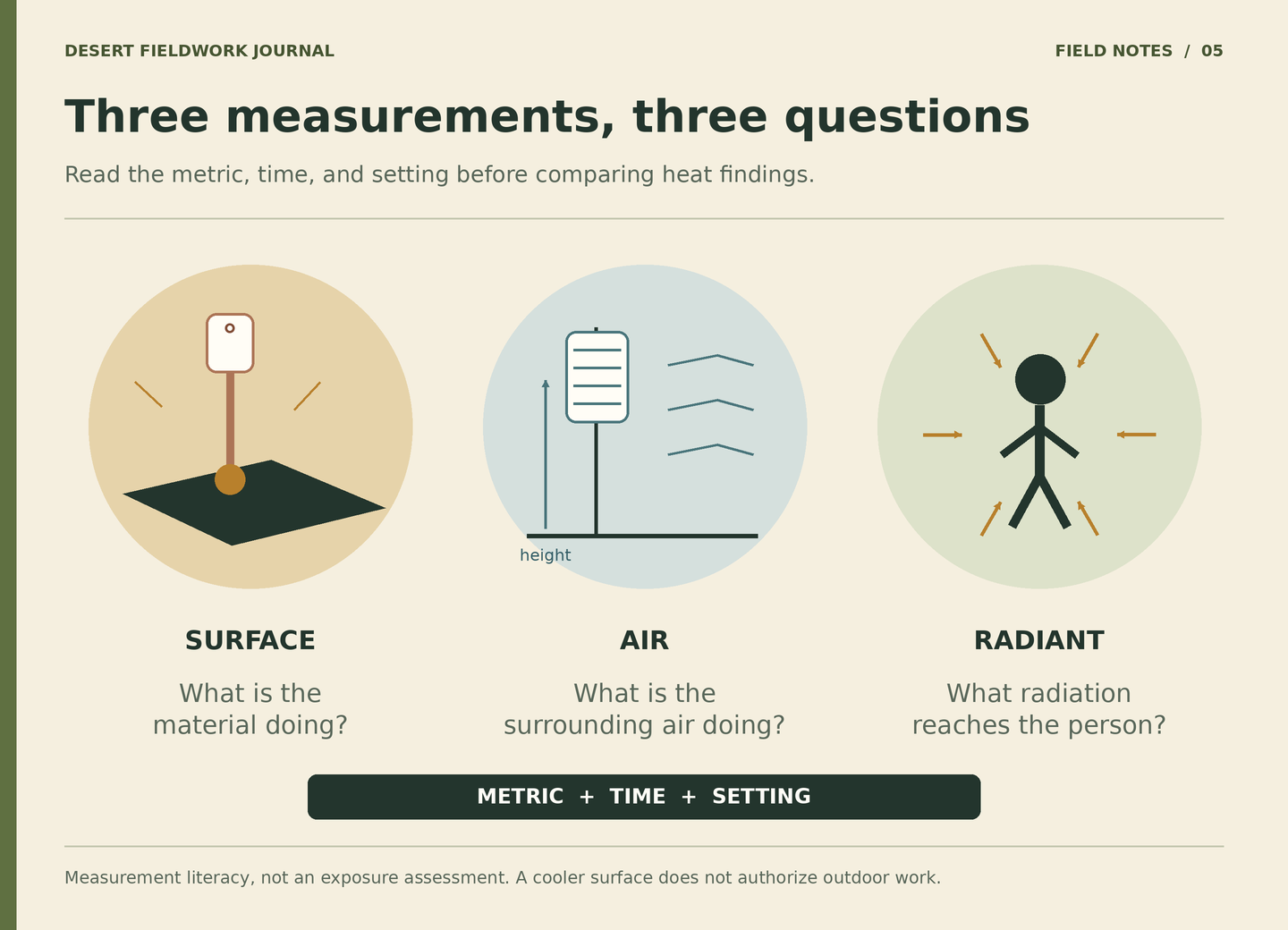
Phoenix’s Cool Pavement Program reports research on reflective pavement treatments. Its results distinguish the temperature of the material, nearby air, and the radiant conditions experienced around a person. Those are separate measurements. A lower surface temperature does not prove that an exposed worker experiences an equivalent reduction in heat stress.
The October 2024 Phase 2 executive summary includes time-of-day and measurement-setting distinctions. Read those limits alongside a headline result. Comparing one surface at noon with air measured elsewhere after sunset would combine unlike evidence. This is measurement literacy, not a judgment about whether a particular street treatment should be used.
An editorial case: a lighter street after preservation
Imagine a hypothetical crew member answering a resident who asks whether a light-colored treated street means nearby work is now cool enough to extend. The worker knows only that a treatment is present. The useful answer is to direct pavement-performance questions to the City program and workplace heat decisions to the applicable department plan. Color alone establishes neither result.
If the resident also reports a rough area, that belongs in a separate location-specific description. Keeping those two questions distinct prevents a conversation about a material’s appearance from becoming an unsupported claim about its heat performance or structural condition.
A short pavement observation output
- Location and observed surface condition, without a proposed repair method
- Nearby use affected, such as a crossing or entrance, if actually observed
- Time and limits of the observation, including what could not be seen
- For a research claim: measurement type, setting, time period, and source date
Career explorers interested in street work can use this distinction to ask better questions about inspection, planning, preservation, and repair assignments. The public source does not establish a current vacancy or authorize technical work. For the workplace side of reflective and exposed surfaces, continue with heat-aware shift preparation.
Sources and limits
Public sources checked October 5, 2026. Editorial examples are hypothetical; official instructions and case-specific decisions remain with the responsible City service.
- Phoenix Street Maintenance Division
Public maintenance scope and broad spring-to-fall routine work season; not a schedule for a specific street.
- Phoenix Cool Pavement Program
City summary of pavement studies and distinct surface, air, and radiant heat measurements; not a worker protection claim.
- Cool Pavement Phase 2 Executive Summary, October 2024
Research measurement distinctions and limits; not a site-specific exposure assessment or universal material performance guarantee.