In this guide
An airport can look like one workplace while containing many employers, responsibilities, and access boundaries. A person working outside near a terminal may have a very different assignment from someone maintaining an authorized airside asset. For Phoenix career explorers, the first useful distinction is therefore the employer and task, followed by the permissions attached to the actual location.
Sky Harbor’s careers page separates City of Phoenix, airline, vendor, and TSA opportunities. It does not make everyone at the airport a City employee. This guide promotes no vacancy and offers no badging, driving, radio, security, or equipment instructions. Current employer and airport requirements govern the work.
Four questions that should never collapse into one
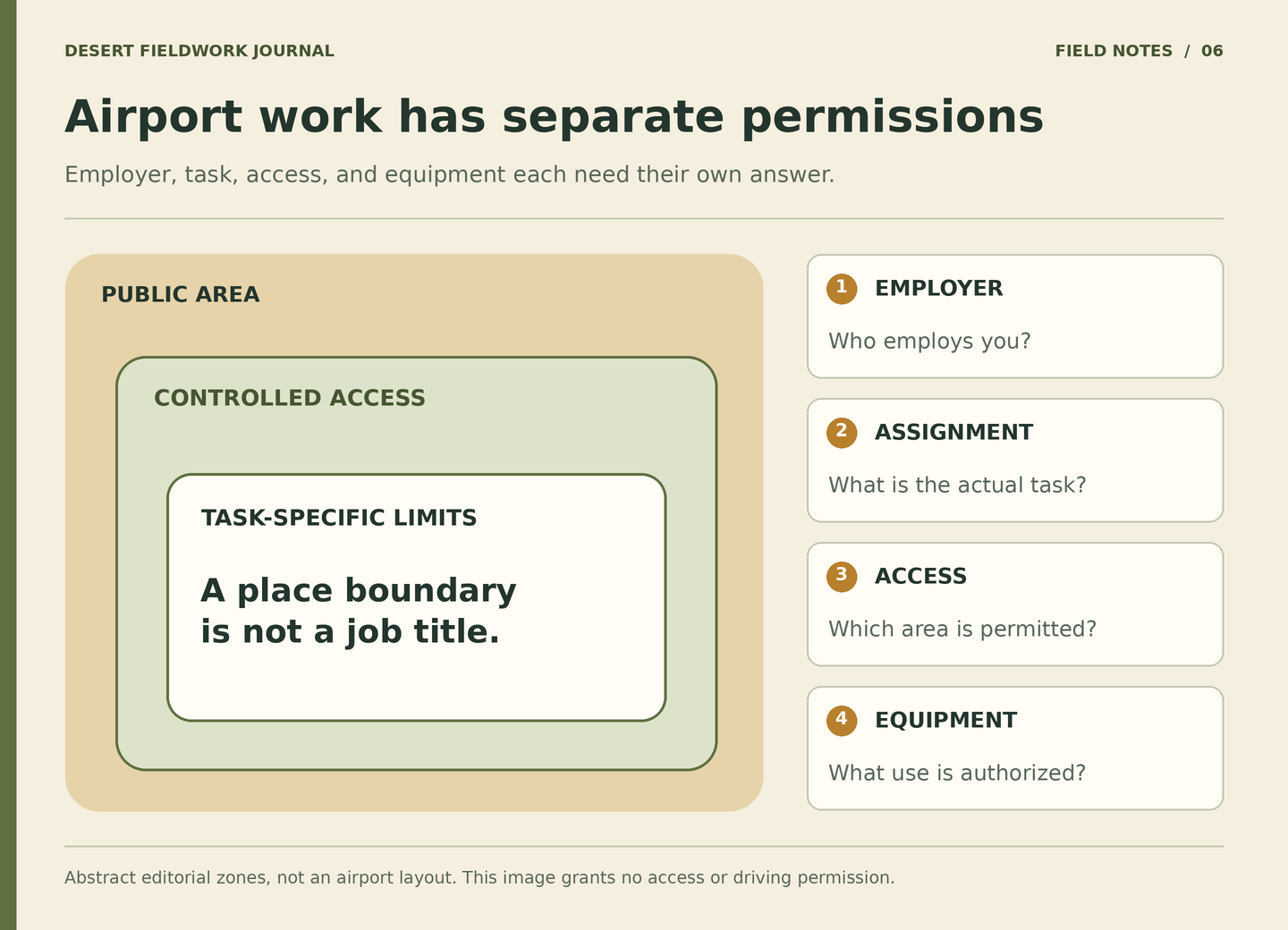
“Do you work at the airport?” establishes very little about what someone may do. Ask separately who employs the person, what the assignment is, which areas that assignment permits them to enter, and which equipment or vehicles they are authorized to use. An answer to one question does not fill the others.
This matters even when the physical task sounds familiar. Work involving pavement, lighting, drainage, landscaping, or a vehicle can carry different requirements in an airport setting. Familiarity with similar equipment elsewhere is not proof of authorization at Sky Harbor, Deer Valley, or Goodyear. The responsible employer must identify the applicable airport and assignment requirements.
Public rules are an orientation source
Sky Harbor’s Rules and Regulations index lists separate subjects including airfield driver’s permits, vehicle operation in the air operations area, and environmental compliance. The existence of those separate subjects is the point for a new reader: outdoor airport work has formal boundaries beyond a general job description.
Do not use a public index as a substitute for required instruction or as a reason to approach a restricted area. An employee who receives an unfamiliar assignment should clarify it through the approved supervisor and airport process. A career explorer can discuss the kinds of responsibilities involved without requesting access, collecting facility-security details, or trying to rehearse an operational procedure.
An editorial case: a familiar vehicle, an unfamiliar destination
Imagine a hypothetical employee asked about using a familiar utility vehicle for a task in an area they have not previously entered. They know how to operate that type of vehicle in another work setting. The unresolved question is not whether they are generally competent; it is whether the assignment, location access, and vehicle authorization all apply here.
The useful preparation is to identify those unresolved items to the responsible supervisor before treating the request as complete. This article does not decide which permission is needed or what route should be taken. It illustrates why a familiar tool does not remove a location-specific boundary.
Outdoor conditions still need assignment-specific planning
Heat, changing weather, and exposure can remain relevant without replacing the airport’s other controls. Ask how the department or employer’s approved plan applies to the actual work area and how assignment changes are communicated. Do not substitute a public terminal’s amenities for confirmed worksite arrangements or assume that a public-area closure describes airside operating status.
A practical orientation card contains only four headings: employer, task, authorized area, and authorized equipment. Under each, record the question that still requires an official answer. Avoid access codes, badge details, security layouts, or private operating information in personal notes. For broader preparation, read heat-aware shift questions. This keeps airport career exploration concrete while leaving operational permission where it belongs.
Sources and limits
Public sources checked October 5, 2026. Editorial examples are hypothetical; official instructions and case-specific decisions remain with the responsible City service.
- Phoenix Sky Harbor Airport Rules and Regulations
Public index of airport access, airside driving, and environmental rules; not a permit, training course, or operational clearance.
- Phoenix Sky Harbor Careers
Distinguishes City, airline, vendor, and TSA employers; no current job fair or vacancy is promoted.