In this guide
- Read the use area before judging its appearance
- Shade has a location and a service life
- Living landscapes are not one watering zone
- Maintenance specialties matter at an ordinary-looking park
- An editorial case: a busy field and a wet connecting path
- Seasons change the questions, not automatically the instructions
- Make a four-part park reading note
- Different facilities need different status checks
- Sources and limits
A Phoenix park is several kinds of public place at once. It can contain a play area, athletic turf, trees, desert-adapted planting, paths, a pool, and buildings. Each part has a purpose and a different pattern of use. A grounds observation becomes much more useful when it connects a visible condition to that purpose instead of assuming that every part of the park should look or operate alike.
For a municipal worker, that perspective supports better questions about the assigned site. For a career explorer, it reveals the practical substance of parks work: sustaining living systems and public facilities while people continue to use them. This independent guide does not supply horticultural prescriptions, equipment instructions, pesticide advice, or authority to change irrigation, close a facility, or alter a tree.
Read the use area before judging its appearance
Begin with what happens in the place. An athletic surface, a walking route, a picnic area, and a natural preserve edge may call for different forms of care. Wear near an entrance can mean something different from a similar-looking patch in a low-use landscape. The observation should identify the use and location before adding a conclusion such as neglected, overwatered, or damaged.
Imagine two brown areas. One might be part of a planned seasonal landscape condition; the other might warrant investigation. A visitor cannot settle that distinction by color alone. A worker unfamiliar with the site should ask what condition is expected, what has already been reported, and who evaluates a change. That question respects the difference between noticing something and diagnosing it.
Shade has a location and a service life
Phoenix’s Urban Forest page treats trees and built shade as important parts of the City’s heat-mitigation landscape. For an observer, the useful question is where the shade reaches a public activity and when. A tree may shade grass while a nearby waiting or walking area remains exposed. A ramada may serve a different use pattern than a line of young trees.
This does not authorize a worker to decide where a new tree belongs or whether a branch should be removed. It suggests better information for the people responsible: the public use being served, the actual location, and the condition observed. “Shade near the east entrance is different after a branch loss” is more useful than “the park needs more trees” when reporting a specific change. See public-tree stewardship for this narrower topic.
Living landscapes are not one watering zone
Phoenix’s shade-tree and plant guidance discusses plants suited to the Valley’s climate. The City’s educational Landscape Maintenance Considerations also distinguishes plant water needs. Those sources support a basic reading principle: trees, turf, and other planting should not be assumed to share an identical irrigation need. They do not establish the approved operating program at a municipal site.
A park can contain mature and recently planted areas, different soils, and systems with distinct purposes. An observer should describe the visible pattern rather than change a controller to make the landscape appear consistent. Useful details might include whether water is reaching a path, whether the condition is localized, and when it was observed. Avoid turning a residential watering tip into instructions for a public asset.
Maintenance specialties matter at an ordinary-looking park
An irrigation controller or pool-related component may appear small and familiar while belonging to specialized work. Phoenix’s published Parks Maintenance Mechanic classification, marked revised May 2010, describes mechanical and irrigation-related responsibilities. We use that older document only to illustrate the existence of specialized duties, not to announce a vacancy or define today’s qualification requirements.
The practical lesson is to ask who is assigned to diagnose and work on a particular system. A grounds task, a plumbing repair, a tree assessment, and an access decision should not be blended because they occur at one address. Good stewardship includes recognizing when a condition belongs to another specialty and preserving enough context for that person to assess it.
An editorial case: a busy field and a wet connecting path
Consider a hypothetical park preparing for an evening activity. A worker on an assigned visit observes water crossing a connecting path beside a field. The field is being used, and a participant asks whether the irrigation can simply be turned off. The employee has not established which system is responsible or whether any adjustment is authorized.
A useful response focuses on the observed path condition and the activity’s access needs. The worker reports the location and timing through the required channel and asks the responsible staff about public access and the landscape system. The employee does not promise that an adjustment will happen or tell participants to use an improvised route. The example shows why irrigation knowledge and public-use awareness both matter without allowing one to replace the other.
Seasons change the questions, not automatically the instructions
As weather and use patterns change, a site may need a different emphasis in its authorized work. The journal cannot supply a universal month for turf work, tree care, irrigation adjustment, or reopening a facility. Even nearby parks can have different assets, schedules, and projects. The Parks and Preserve Initiative illustrates how park investments can combine paths, irrigation, lighting, and other facilities; a listed project should not be assumed active today.
For preparation, ask which changes are planned at this park and what those changes mean for the assigned area. Is a route affected by maintenance? Is a public program using a different entrance? Does the landscape condition have an expected explanation? Which temporary signs or public notices are current? These questions are concrete enough for a site conversation and leave technical decisions with authorized staff.
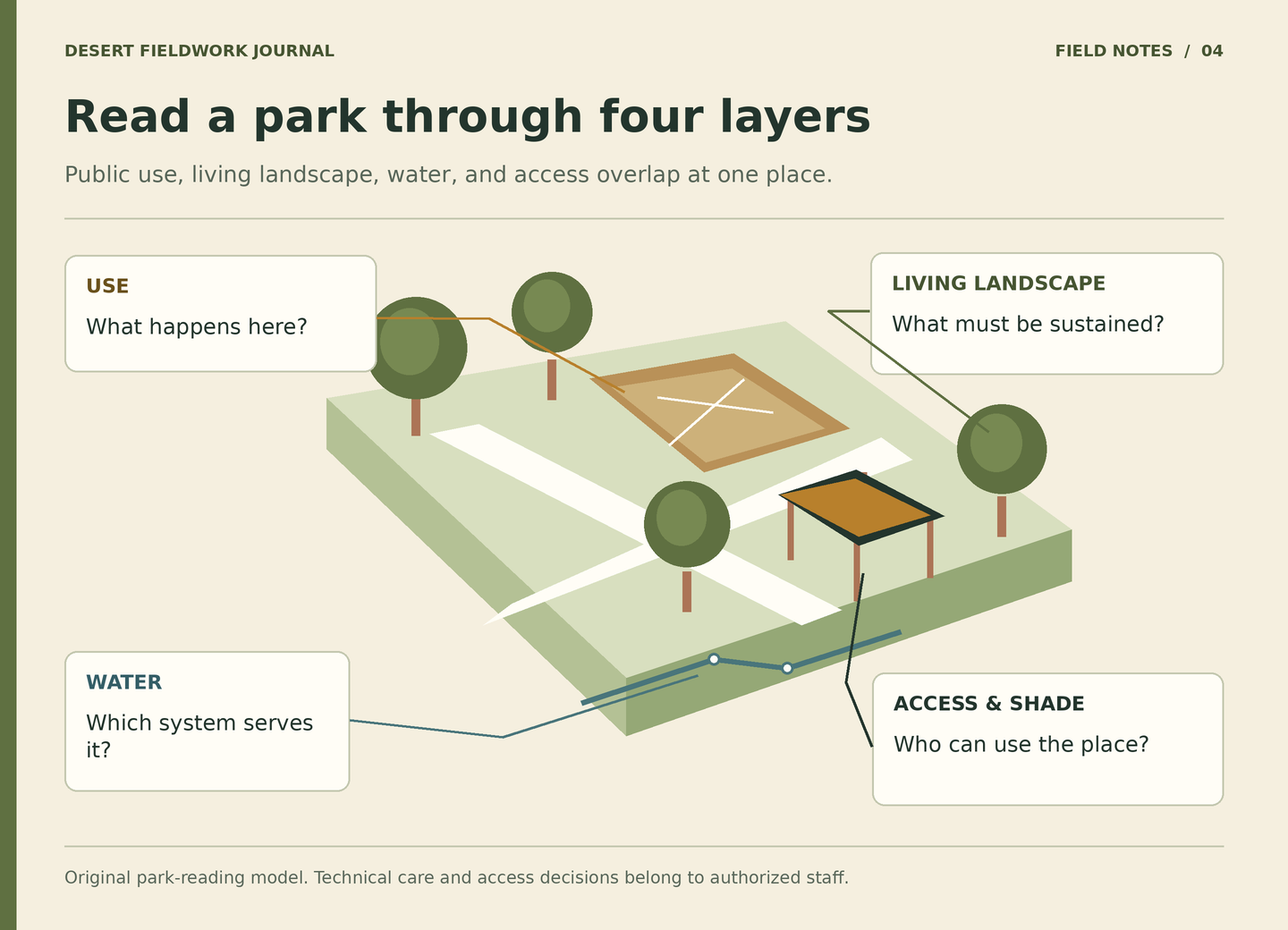
Make a four-part park reading note
- Use: identify the particular activity or public route and when the observation matters
- Living landscape: describe visible conditions without diagnosing a tree, soil, or irrigation problem
- Infrastructure: identify the visible feature if known, while leaving concealed systems and controls alone
- Access: record the observed effect on paths, entrances, shade, or facilities and the official question still needing an answer
Keep the note proportionate. A parks employee should use the employer’s reporting process rather than create a parallel public database. A career explorer can practice the distinction using a clearly hypothetical example or public information. Neither needs to photograph visitors or collect personal details to understand how stewardship works.
Different facilities need different status checks
A pool’s season, a trail’s heat restriction, and a neighborhood park’s opening information are separate matters. Avoid giving one park-wide answer based on a single amenity. The pool seasonal-transition guide explains why a public closure and maintenance activity can coexist. The trail restriction guide shows why a published trigger is different from today’s confirmed access status.
The best broad parks question is therefore surprisingly specific: what is this part of this place supposed to provide now, and who confirms a change? That keeps attention on a public asset’s real purpose while making room for the specialist work needed to sustain it.
Sources and limits
Public sources checked October 5, 2026. Editorial examples are hypothetical; official instructions and case-specific decisions remain with the responsible City service.
- Phoenix's Urban Forest
Public tree and shade objectives and managed urban landscape context; no tree health diagnosis or maintenance authorization.
- Phoenix Shade Trees and Other Plants
Desert-adapted landscape and public shade context; residential guidance is not a municipal irrigation prescription.
- Landscape Maintenance Considerations
Educational landscape context about different plant water needs; not an operating schedule for a public park.
- Phoenix Parks and Preserve Initiative
Examples of park and preserve investments including paths, irrigation, and facilities; no claim that a listed project is currently active.
- Parks Maintenance Mechanic, Job Code 40160
Classification document marked revised May 2010, used only to illustrate specialized irrigation and mechanical work; not a current vacancy or eligibility guide.